


The Musée d’Orsay is housed in a former railway station — the Gare d’Orsay, the world’s first electrified urban rail terminal, built in just two years for the 1900 Paris Universal Exhibition. The museum opened on 1 December 1986 and houses the world’s largest collection of Impressionist and Post-Impressionist art — approximately 500 Impressionist and 1,100 Post-Impressionist paintings.Dedicated entrance tickets are €18. Open Tuesday to Sunday, 9:30 am–6 pm (Thursday until 9:45 pm). Closed Mondays.
The Musée d’Orsay is not just one of the world’s great art museums — it is also one of the most fascinating buildings in Paris. Before the Impressionists moved in, this extraordinary Beaux-Arts structure on the Left Bank of the Seine served as a railway station, a WWII mailing centre, a holding pen for returning prisoners of war, a theatre, and almost as a hole in the ground. The story of how the Gare d’Orsay became the Musée d’Orsay is almost as remarkable as the collection it houses.
Top Ticket
19 Fascinating Musée d’Orsay Facts
1. It Was Built for the 1900 Paris Universal Exhibition
In 1900, Paris hosted the Universal Exhibition — a massive world’s fair showcasing the achievements of the previous century, which drew over 50 million visitors between April and November. The French Government needed a new railway terminus to handle the crowds, positioned close to the exhibition site on the Left Bank. The result was the Gare d’Orsay, built in two years and inaugurated on 28 May 1900, just in time for the opening.
Musee d Orsay is the 5th most visited site in France. The other attractions in Paris, in order of their popularity, are – Louvre Museum, Palace of Versailles, the Eiffel Tower and Disneyland Paris.
Buy This Ticket2. It Was the World’s First Electrified Urban Rail Terminal
The Gare d’Orsay made history as the world’s first electrified urban rail terminal. This was a technological breakthrough — previous railway stations used steam engines, which were noisy, dirty, and impractical in the centre of a city like Paris. Electric trains were quieter, cleaner, and far better suited to a central terminus adjacent to the residential and governmental heart of the French capital. The innovation made the station a model for urban rail stations across Europe.
3. Three Architects Built It in Two Years
The railway station was designed by three architects — Lucien Magne, Émile Bénard, and Victor Laloux — with Laloux leading the team. Constructing a large, complex terminal in just two years was a remarkable feat of engineering and project management. The station was inaugurated on 28 May 1900, on schedule, and ready for the Universal Exhibition crowds. Laloux deliberately masked the iron-and-metal industrial structure behind an ornate Beaux-Arts facade of limestone to match the neighbouring Louvre and Palais du Louvre on the opposite bank.
4. The Building Contains More Metal Than the Eiffel Tower
The Gare d’Orsay’s construction required 12,000 tonnes of metal — more than the 7,300 tonnes used in the construction of the Eiffel Tower. The difference is that at the Orsay, the metal is concealed behind stone cladding and ornamental detail, making the building appear entirely traditional from outside while being structurally as daring as any industrial engineering project of its era.
5. The Building Has 35,000 Square Metres of Glass
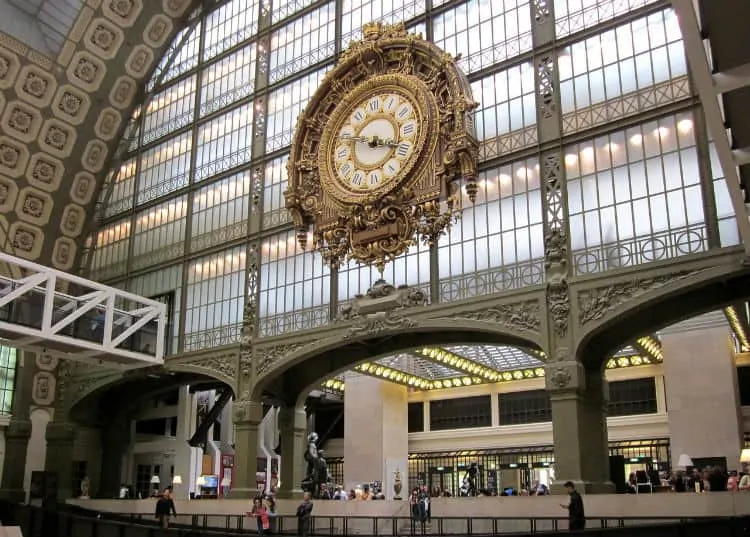
The Gare d’Orsay incorporated an extraordinary 35,000 square metres of glass — the equivalent of nearly five football pitches. This glass floods the museum’s central nave with natural light, which is partly why the Impressionist paintings — which rely on the subtle play of natural light — look so magnificent here. The massive vaulted glass roof, stretching 140 metres along the central hall, is the building’s most spectacular architectural feature.
6. It Had a 370-Room Hotel Built Around It
Because the Gare d’Orsay’s interior was primarily functional ironwork — not particularly beautiful — architect Victor Laloux decided to encase the station on its western and southern sides with a luxury hotel: the Hôtel d’Orsay, with 370 rooms. The hotel was extremely popular with both tourists visiting Paris and French political parties, which used it for meetings and congresses. As its character faded and its facilities aged, the hotel closed in 1973.
7. The Platforms Became Too Short Within 40 Years
The railway station’s operational life was shorter than anticipated. By the 1930s, train technology had advanced to the point where new trains were simply too long for the Gare d’Orsay’s platforms. The station could no longer handle mainline services and was downgraded to a suburban terminus. Less than 40 years after its inauguration, the once-pioneering station was effectively obsolete.
8. It Was Used as a Mailing Centre and Refugee Reception During WWII
During the German Occupation of Paris (1940–1944), the Gare d’Orsay was converted into a mailing centre for packages sent to French prisoners of war. After the Liberation in 1944, it became a reception centre for returning French prisoners and forced labourers — the first place many of them saw on returning to France after years of captivity. A commemorative plaque on the Seine-facing wall of the building marks this use and the thousands who passed through.
Must Read: What you must know before buying Musee d’Orsay tickets
Visual Story: 14 must-know tips before visiting Musee d’Orsay
9. Orson Welles Filmed Scenes Here
During the long decades when the Gare d’Orsay lay disused, the building attracted filmmakers drawn to its dramatic, decaying grandeur. Orson Welles used it as a location for his 1962 film The Trial, adapted from Franz Kafka’s novel. The vast, empty concourse and its strangely inhuman scale made it the perfect setting for Kafka’s bureaucratic nightmare. Several other films and television productions used the abandoned station in the 1950s and 1960s.
10. It Was Almost Demolished in 1970
The station’s fate seemed sealed in 1970 when permission was granted to demolish it and replace it with a large modern hotel. Plans were advanced, and the building’s future looked bleak. The intervention that saved it came from an unlikely source: Jacques Duhamel, France’s Minister for Cultural Affairs, who personally blocked the demolition and had the Gare d’Orsay placed on France’s supplementary register of Historic Monuments. Without Duhamel’s intervention, the building would almost certainly not exist today.
Many tourists are confused if they must visit Louvre or d’Orsay. To decide, read our analysis of Musee d’Orsay vs. Louvre Museum.
11. A French Painter Predicted Its Transformation 86 Years Earlier
In one of history’s more unlikely prophecies, French artist Édouard Détaille visited the newly opened Gare d’Orsay in 1900 and reportedly remarked that the building was so beautiful it would be better suited as a museum than a railway station. Eighty-six years later, President François Mitterrand’s government did exactly that.
12. Three Overflowing Museums Made the Orsay Necessary
The decision to create the Musée d’Orsay was partly practical: three major Paris museums were simultaneously struggling with overflowing collections. The National Museum of Modern Art was moving from the Palais de Tokyo to the new Centre Pompidou and had art to dispose of. The Jeu de Paume museum, Paris’s dedicated Impressionist gallery since 1947, was bursting at the seams. The Louvre was keeping over 75% of its 19th-century collection in storage. The solution: a new museum specifically for French art from 1848 to 1914.
13. Three Young Architects Won the Conversion Competition
In 1978, an architectural competition was held to convert the Gare d’Orsay into a museum. Six proposals were received; the winning entry came from ACT Architecture, a practice run by three young architects — Pierre Colboc, Renaud Bardon, and Jean-Paul Philippon. Their project created 20,000 square metres of new floor space across four levels within the existing building’s shell.
14. The Interior Design Was Called ‘Mussolinian’
In 1981, Italian architect Gae Aulenti was commissioned to design the museum’s interior — the furniture, fittings, internal arrangement, and decorative elements. Her design proved highly controversial: some critics and art historians felt her heavy stone structures had a monumental, oppressive quality reminiscent of 1930s Fascist architecture. The debate about whether the interior successfully serves the collection it houses has never been entirely resolved, though the overall effect is now simply the Orsay.
15. François Mitterrand Opened It on 1 December 1986
President François Mitterrand — the same socialist president who commissioned the Louvre Pyramid — inaugurated the Musée d’Orsay on 1 December 1986. It opened to the public on 9 December. On the very first day, over 20,000 people queued to get in — a record for any museum opening in France and a sign of the extraordinary public appetite for the collection.
16. It Has the World’s Largest Impressionist Collection
Today the Musée d’Orsay houses approximately 500 Impressionist and 1,100 Post-Impressionist paintings — the most extensive collection of this period anywhere in the world. This includes works by Monet, Renoir, Degas, Pissarro, Sisley, Manet, Cézanne, Van Gogh, Gauguin, and Seurat, among many others. The collection was assembled from the Jeu de Paume, the Louvre’s 19th-century holdings, and decades of subsequent acquisitions.
17. The Famous Clocks Are Original Railway Station Fittings
Three large ornamental clocks survive from the original Gare d’Orsay. Two are set into the museum’s external facade — one facing the Seine, one facing the Tuileries Garden — and one is inside the building at the end of the central nave. They were installed in an era when large public clocks were essential (personal watches were expensive luxuries), and they remain the most instantly recognisable features of the building’s exterior. Looking through the large clock face on the Seine side offers one of the most photographed views in Paris: Notre Dame Cathedral framed by the Roman numerals.
18. Six Forgotten Continental Statues Were Rescued From a Dump
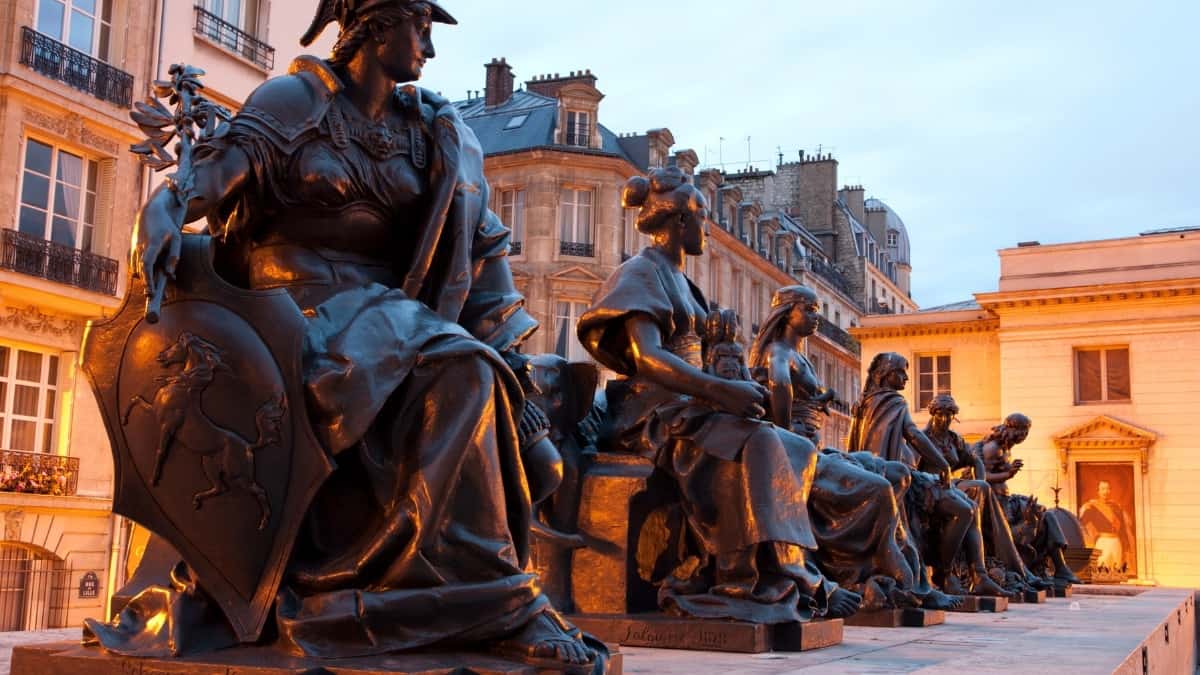
Outside the Orsay stand six large bronze allegorical figures representing the six inhabited continents: Europe, Africa, Asia, Oceania, North America, and South America. These were created for the Trocadéro Palace during the 1878 Paris Universal Exhibition. Forgotten and displaced over the following decades, they were sent to a public dump in Nantes in 1963. The Musée d’Orsay tracked them down and acquired them — exchanging an Alfred Sisley painting with the Musée des Beaux-Arts de Nantes in return.
19. Photography Was Banned Until a Minister Broke the Rules
Until 2015, photography was banned inside the Musée d’Orsay — one of the last major Paris museums to maintain the prohibition. In 2014, France’s Ministry of Culture issued a non-binding recommendation that photography should be allowed at all national museums; the Orsay refused to comply. In 2015, French Culture Minister Fleur Pellerin visited the museum, took a photograph of a famous painting, and posted it on Instagram. The resulting public controversy — why could a minister photograph works that ordinary visitors couldn’t? — forced the museum to lift the ban within days.
Musée d’Orsay Quick Facts
| Fact | Detail |
| Original use | Gare d’Orsay railway station (1900–1939) |
| Architects (station) | Victor Laloux, Lucien Magne, Émile Bénard |
| Conversion architects | ACT Architecture (Colboc, Bardon, Philippon) |
| Interior design | Gae Aulenti (Italian architect, 1981) |
| Museum opening | 1 December 1986 |
| Length | 175 metres |
| Central hall length | 140 metres |
| Metal in construction | 12,000 tonnes (more than Eiffel Tower) |
| Glass surface | 35,000 square metres |
| Collection period | French art, 1848–1914 |
| Impressionist paintings | ~500 works |
| Post-Impressionist paintings | ~1,100 works |
| Photography collection | ~45,000 photographs (oldest from 1839) |
| Annual visitors | ~3.5 million |
| Ticket price (2026) | €18 (dedicated entrance) |
FAQs about the Musée d’Orsay
Here are some frequently asked questions about Musée d’Orsay.
Was the Musée d’Orsay always a museum?
No — it was built as the Gare d’Orsay railway station for the 1900 Paris Universal Exhibition, making it the world’s first electrified urban rail terminal. It operated as a station until the 1930s, then served various other purposes (WWII mailing centre, film location, theatre) before nearly being demolished in 1970. It became the Musée d’Orsay when it opened on 1 December 1986.
How much metal is in the Musée d’Orsay building?
12,000 tonnes — more than the 7,300 tonnes used in the Eiffel Tower. The difference is that all the metal at the Orsay is concealed behind ornate stone cladding.
Why does the Musée d’Orsay look like a railway station?
Because it was one. The massive vaulted iron-and-glass roof over the central nave was the station’s grand concourse. The famous clocks are original station fittings. What is now the central sculpture gallery was once the main platform area.
When did the Musée d’Orsay open?
The museum was inaugurated by President François Mitterrand on 1 December 1986, and opened to the public on 9 December 1986. Over 20,000 people visited on the first day.
