

Every day, over 30,000 tourists visit the Louvre Museum in Paris — and among them, at least 25,000 make their way to see Leonardo da Vinci’s Mona Lisa. Visitors often spend over five minutes in front of this iconic painting, making it the most viewed artwork in the museum and the most famous painting in the world.
The Mona Lisa is displayed in Room 711 (Salle des États) on the 1st floor of the Denon Wing inside the Louvre Museum. This is the largest room in the museum. The painting is protected behind a thick, bulletproof glass barrier in a climate-controlled setting. No separate Mona Lisa ticket is required — a standard Louvre Museum entry ticket gives access to all exhibits, including the Mona Lisa.
This guide covers everything you need to know — from buying tickets and finding the painting to the best time to visit, what to expect, and the fascinating history behind Leonardo’s masterpiece.
Top Tickets
# Louvre Museum general admission
# Guided tour with introduction to Mona Lisa
# Guided tour customized for children
Table of Contents
Mona Lisa: What to Expect
Many visitors are surprised to discover that the Mona Lisa is not the large, imposing painting they imagined. Measuring just 77 cm × 53 cm (2.5 ft × 1.7 ft), it is remarkably small compared to its towering global reputation.
The Louvre has gone to great lengths to protect this iconic work. The painting has been behind bulletproof glass since the early 1950s, following an incident where a visitor damaged it with acid. In 2019, the museum upgraded to a more advanced, transparent bulletproof glass — improving the viewing experience by making the painting appear closer while maintaining uncompromised security.
Some visitors feel disappointed
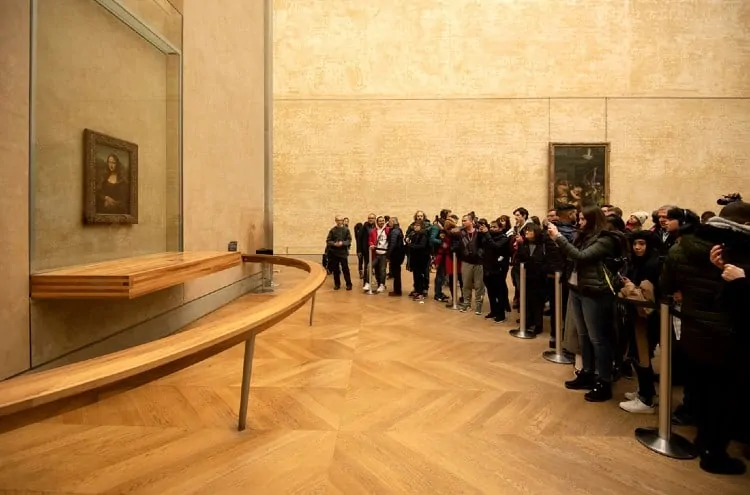
Despite the immense anticipation fueled by the Mona Lisa’s status as the world’s most famous painting, some visitors feel let down when they finally stand in Room 711. The painting’s modest size, the protective glass barrier, and the surrounding crowds can make it feel distant and harder to appreciate up close.
Yet even visitors who initially feel underwhelmed agree that the Mona Lisa’s mysterious smile is genuinely captivating in person. Its modest dimensions and enigmatic expression have kept this artwork legendary for over 500 years.
To avoid disappointment, we recommend reading this guide thoroughly so you arrive with the context and appreciation needed to fully enjoy Leonardo’s masterpiece.
Related: 16 tips for a good visit to the Louvre Museum
How to get there
Grab a museum map at the entrance to find the fastest route to the painting. There are also signs throughout the museum pointing the way to the Mona Lisa.
Tickets to See the Mona Lisa at the Louvre
You do not need a separate Mona Lisa ticket. A regular Louvre Museum ticket grants access to all exhibits, including the Mona Lisa.
Buy This TicketIf seeing the Mona Lisa is your primary reason for visiting, consider the Louvre entry ticket that comes with guided introduction to the Mona Lisa — an expert provides context about the painting’s history, techniques, and mysteries before you view it.
Buy This TicketFor a deeper art experience, a guided tour of the Louvre Museum ensures you don’t miss any masterpieces while hearing in-depth commentary from an art expert. Visitors who want complete control over their itinerary can book a private guided tour of the Louvre Museum.
Families visiting with children should consider this guided tour customized for kids — the tour begins with the Mona Lisa before moving to other child-friendly exhibits.
Taking photographs of the Mona Lisa
Photography without flash is allowed, but be aware that taking the perfect shot can be difficult with the number of people vying for a front-row view.
Where Is the Mona Lisa Located?
The Mona Lisa is displayed in the Denon Wing, within the Paintings section. Specifically, it hangs in Room 711 (Salle des États) on the 1st floor — the largest room in the Louvre Museum.

Nearby sculptures on the 1st floor include Antonio Canova’s Psyche Revived by the Kiss of Love, Michelangelo’s Dying Slave, and the iconic Winged Victory of Samothrace at the top of the Daru staircase.
Alongside the Mona Lisa, you’ll find two other remarkable paintings on the first floor: Jacques-Louis David’s The Coronation of Napoleon and Delacroix’s Liberty Leading the People.
On the same floor, don’t miss the chance to admire three stunning sculptures —Antonio Canova’s Psyche Revived by the Kiss of Love, Michelangelo’s Dying Slave, and the iconic Winged Victory of Samothrace.
Note: This tour is not suitable for tourists using wheelchairs and those with mobility impairments
Best Time to See the Mona Lisa
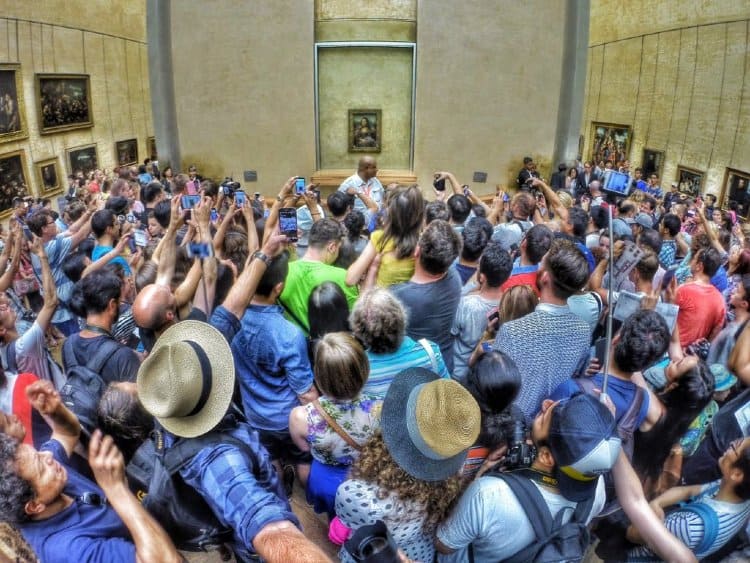
The best time to see the Mona Lisa is right when the Louvre opens at 9 am. Head directly to Room 711 on the 1st floor of the Denon Wing to get a clear view before crowds build up. If a morning visit is not possible, your next best window is after 4 pm, when large tour groups and school visits have departed.
On Wednesdays and Fridays, the Louvre stays open until 9 pm, making evenings an ideal time to view the Mona Lisa with significantly fewer visitors. For the quietest experience, arrive between 7 and 8 pm on a late-opening day.
For a complete guide to evening visits, including entrance tips, photo spots, and crowd data, see our guide to visiting the Louvre Museum at night.
Purchasing your Louvre Museum tickets online in advance lets you skip the ticket queues and be among the first inside when doors open.
Whether you’re a fan of the Mona Lisa or not, it’s a good idea to learn all about the Louvre Museum before purchasing your tickets.
History of the Mona Lisa
Leonardo da Vinci began painting the Mona Lisa around 1503 in Florence, Italy. Art historians believe the portrait depicts Lisa Gherardini, the wife of Florentine merchant Francesco del Giocondo — which is why the painting is also known as La Gioconda.
The merchant commissioned the portrait to honor his wife, but Leonardo never delivered it. He carried the painting with him for over 15 years until his death in 1519 in France, when he bequeathed it to his friend and patron, King François I. The King later hung it in the Appartement des Bains at the Palace of Fontainebleau.
Following the French Revolution, the Mona Lisa mostly resided in the Louvre Museum — except for a brief period when Napoleon Bonaparte had it hung in his bedroom at the Tuileries Palace.
In 1911, the painting was famously stolen by Vincenzo Peruggia, an Italian nationalist working as a Louvre security guard. He believed the masterpiece belonged in Italy. Two years later, he was caught trying to sell it to an art dealer in Florence — and the global media coverage of the theft largely transformed the Mona Lisa into the cultural icon it is today.
For more fascinating stories about the painting and the museum, see our collection of Louvre Museum facts.
The Louvre or d’Orsay?
Leonardo Da Vinci’s Mona Lisa is one of the significant differences between Musee d’Orsay and The Louvre. If you aren’t sure which art gallery to visit, check out our comparison of the two Parisian landmarks.
Frequently Asked Questions About the Mona Lisa
Who painted the Mona Lisa?
Leonardo da Vinci — one of history’s greatest geniuses, also renowned as an architect, engineer, and inventor — painted the Mona Lisa between 1503 and 1506 (though he may have continued refining it for years afterward).
What is the Mona Lisa’s original size?
The painting measures 77 cm × 53 cm (2.5 ft × 1.7 ft). A frame surrounds it in the Louvre, making it appear slightly larger than the actual canvas.
How long did the Mona Lisa take to paint?
According to Giorgio Vasari, Leonardo da Vinci’s biographer, the painter began the work in 1503 and spent approximately four years on it. The slow pace is attributed to his use of the sfumato technique — applying paint in extremely thin layers, letting each dry before adding the next.
Is the Mona Lisa a real person?
Yes. Art historians generally agree the subject is Lisa Gherardini, a real Florentine woman born and raised in Florence. She died in 1542 at the age of 63.
Is the Mona Lisa smiling?
Yes. Her mysterious smile has captivated viewers for centuries. Dutch researchers at the University of Amsterdam ran the Mona Lisa through emotion-recognition software and determined her expression was 83% happy, 9% disgusted, 6% fearful, 2% angry, less than 1% neutral, and 0% surprised.
Why does the Mona Lisa have no eyebrows?
Art experts believe Leonardo originally painted eyebrows. However, early restoration efforts — conducted before modern preservation technologies — accidentally wiped them away. In 2007, Parisian engineer Pascal Cotte used 240-megapixel scans to discover traces of a left eyebrow hidden beneath centuries of restoration work.
Is the original Mona Lisa in the Louvre?
Yes. The original Mona Lisa, painted by Leonardo da Vinci, has been part of the Louvre’s permanent collection for over two centuries. It was first installed in the Grand Gallery of the Louvre in 1804.
Why is the Mona Lisa in the Louvre?
When Leonardo died in 1519, he left the painting to King François I of France. After the French Revolution (1789–1799), royal art collections were transferred to public institutions, and the Mona Lisa moved to the Louvre Museum in 1804.
Why is the Mona Lisa considered a masterpiece?
The painting is celebrated for Leonardo’s mastery of the sfumato technique — applying thin layers of paint to create soft, smoky transitions between colors. This painstaking process (Leonardo spent an estimated four years on it) gives the painting its lifelike quality and Mona Lisa’s mysteriously soft expression.
How much is the Mona Lisa worth?
Museums like the Louvre own their masterpieces for public enjoyment and never sell them, making works like the Mona Lisa technically priceless. In 1962, the painting was valued at $100 million for insurance purposes — equivalent to approximately $1 billion in 2026 when adjusted for inflation. Guinness World Records lists it as having the highest-ever insurance value for a painting.
When was the Mona Lisa first displayed publicly?
The Mona Lisa was first shown to the public in the 1530s by King François I, who displayed it in a semi-public art gallery at the Palace of Fontainebleau.
Which is the best copy of the Mona Lisa?
The most notable copy is at Madrid’s Museo del Prado. Art experts believe it was painted simultaneously with the original, possibly by Leonardo’s studio assistant Gian Giacomo Caprotti (known as Salaì). Conservation analysis shows both paintings underwent identical compositional changes at the same stages, suggesting they were created side by side.
