
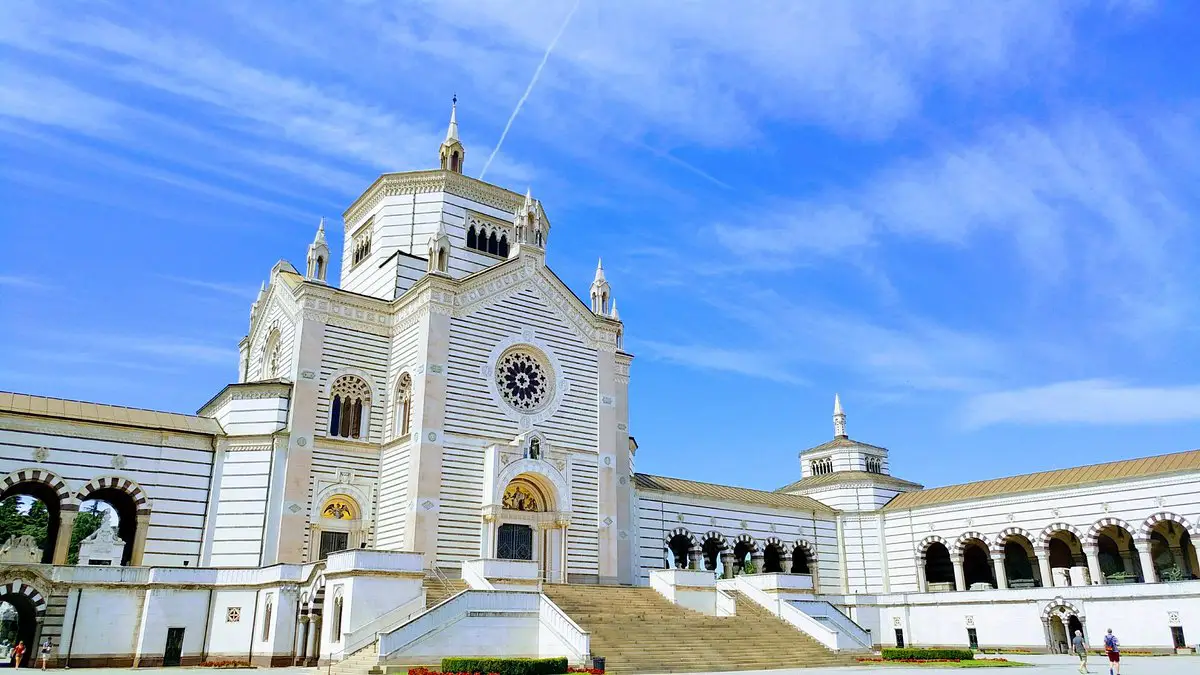
Cimitero Monumentale is Milan’s grand 19th-century cemetery, an open-air museum of elaborate tombs, chapels and sculpture spread across some 250,000 square metres. Entry is free. It opens Tuesday to Sunday, roughly 8:00 to 18:00, and is closed on Mondays. The marble Famedio at the entrance and the grave of conductor Arturo Toscanini are the signature stops.
Most travellers do not put a cemetery on their Milan list, and most travellers are wrong. Cimitero Monumentale, opened in 1866 to a design by architect Carlo Maciachini, is not a quiet field of headstones but a vast sculpture park where the wealthy families of industrial Milan competed to be remembered in marble and bronze. The result is a century and a half of Italian art in the open air, free to wander and rarely crowded.
Set in the northwest of the city near Porta Garibaldi and the Porta Nuova district, the cemetery gathers Greek temples, towering obelisks, weeping angels, art nouveau chapels and even a scaled-down copy of Trajan’s Column. Sculptors including Adolfo Wildt, Medardo Rosso, Lucio Fontana and Gio Ponti left work here, and modern skyscrapers now rise just beyond the walls, so a visit reads as a walk through Milan’s whole story – old money, new towers and everything between.
This guide covers what to see, the best time to come, how long to allow, and exactly how to reach the cemetery by Metro or tram. Treat it as you would any working cemetery: it is still in use, so keep your voice down and dress with a little respect.
Table of Contents
Cimitero Monumentale Opening Hours
Cimitero Monumentale is open Tuesday to Sunday, from 8:00 to 18:00, and closed on Mondays. Last entry is shortly before closing. Admission is completely free. Hours can vary on public holidays, so check before a holiday visit. There is no ticket and no queue – you simply walk in through the main gate.
The cemetery keeps the same rhythm year-round, with the gates open early and closing at 18:00 in the evening. Mornings are quietest and the light is best for photography; arrive well before closing so you are not rushed off the avenues by the guards. Because it is a functioning cemetery run by the Comune di Milano, opening can be shortened on major holidays such as All Saints’ Day, when local families visit graves.
Best Time to Visit
Come on a weekday morning soon after the 8:00 opening for the calmest atmosphere and the softest light on the marble. Spring and autumn are the most comfortable seasons, with mild temperatures for slow walking. Avoid Mondays, when it is closed, and the days around All Saints’ Day (1 November), when it is busy with families tending graves.
The Monumentale rewards an unhurried visit, and unhurried is easiest first thing in the day, when tour groups are still queuing for the Duomo across town. Overcast days flatter the pale statuary and the greenery, while high summer can be hot and shadeless on the open avenues. Whenever you come, allow the place to slow you down – this is a spot for wandering, not ticking off.
How Long Does a Visit Take?
Plan on about one to two hours. A quick loop past the Famedio and the central monuments takes under an hour, but the side avenues, the family chapels and the sculpture reward a slower pace. Photographers and art lovers can happily spend a full half-day. Pick up a free map at the entrance to find specific graves.
There is no single route, and that is part of the pleasure – you drift from one extravagant tomb to the next, following whatever catches your eye. The Famedio and the main axis behind it can be seen in forty-five minutes, but the deeper you go into the numbered fields, the more strange and beautiful the memorials become. Grab the map by the gate if you want to track down a particular grave rather than trust to luck.
What to See at Cimitero Monumentale

The highlights are the Famedio, the vast Neo-Medieval Hall of Fame at the entrance, the grave of conductor Arturo Toscanini, the art nouveau and symbolist family tombs by sculptors such as Adolfo Wildt, and the historic Crematorium Temple. Look too for the scaled-down Trajan’s Column and the many monumental bronze and marble figures lining the avenues.
The Famedio
The first thing you meet is the Famedio, a huge striped building in marble and stone that fronts the whole cemetery like a cathedral. Built as a church and repurposed as a Hall of Fame, it honours Milan’s distinguished dead, chief among them the novelist Alessandro Manzoni, whose tomb sits inside. Walk through its cool, decorated interior before heading out to the graves – it sets the tone for everything beyond.
Toscanini and the famous graves
Behind the Famedio the ground fills with the tombs of Milan’s great and good. The most visited is that of Arturo Toscanini, the conductor who led La Scala and shaped 20th-century music; his family monument is a place of quiet pilgrimage. Nearby lie industrialists, poets, publishers and artists, many marked by sculptures as ambitious as anything in a museum. If opera is your reason for being in Milan, pair this with the La Scala theatre and museum in the centre.
Art nouveau and symbolist tombs
The real treasure is the sculpture. Wealthy Milanese families hired the best artists of their day, and the result is an open-air survey of Italian funerary art – grieving angels, allegorical figures, and dramatic reliefs in styles running from sober classicism to feverish Liberty (Italian art nouveau) and symbolism. Watch for the intense, polished marbles of Adolfo Wildt and works touched by Medardo Rosso and later Lucio Fontana. Some tombs, such as the Campari family monument, even reproduce famous scenes like the Last Supper.
The Crematorium Temple and Trajan’s Column
Toward the rear stands the Crematorium Temple, built in a severe Greek Revival style and, when it opened in 1876, the first crematorium in the Western world – a striking piece of Milanese ambition. Elsewhere among the avenues you will spot a scaled-down copy of Trajan’s Column and other borrowings from antiquity, testament to how far these families reached for grandeur.
Is Cimitero Monumentale Worth It?
Yes. For anyone with an interest in art, architecture or Milan’s history it is one of the city’s most rewarding free sights – a genuine open-air sculpture museum without the crowds or the ticket price. It sits a little outside the central sightseeing core, so it rewards visitors who have a couple of hours and want something quieter and more unusual than the usual stops.
If your idea of travel includes wandering somewhere beautiful and slightly unexpected, the Monumentale is a highlight of Milan, not a footnote. It costs nothing, it is rarely busy, and the quality of the sculpture genuinely surprises people. First-time visitors on a tight one-day schedule may prioritise the Duomo and the Last Supper instead, but with a spare morning this is one of the best things you can do in the city for free.
Things to Know Before You Go
- Entry is completely free and there is no ticket; just walk in through the main gate during opening hours.
- It is closed every Monday and opens Tuesday to Sunday, roughly 8:00 to 18:00, with shortened hours possible on public holidays.
- This is a working cemetery – keep your voice low, dress modestly, and be discreet with photography around anyone visiting a grave.
- Pick up the free map at the entrance to locate specific tombs such as Toscanini’s; the grounds are large and easy to get lost in.
- There is little shade on the open avenues, so bring water and a hat in summer and sturdy shoes for the gravel paths year-round.
How to Get to Cimitero Monumentale
The cemetery stands at Piazzale Cimitero Monumentale, northwest of the centre near Porta Garibaldi and the Porta Nuova business district. The easiest approach is the Metro: take the M5 (lilac) line to Monumentale station, which brings you out right beside the entrance.
Alternatively, ride the M2 (green) line to Garibaldi FS and walk about 400 metres, or take ATM trams 2, 4, 12 or 14, which stop close by. A single urban ticket costs about EUR 2.20 and covers 90 minutes across Metro, tram and bus. From Milano Centrale it is a short hop: one stop on the M5 from Garibaldi, or a 15-minute walk.
Central Milan is walkable, and the cemetery pairs naturally with the modern district on its doorstep – the Bosco Verticale towers and Piazza Gae Aulenti are a 10-minute stroll away, and the greenery of Parco Sempione and Sforza Castle lie to the south. Arriving from Malpensa (MXP), Linate (LIN) or Bergamo (BGY) airports, take the Malpensa Express or an airport bus to Milano Centrale, then the M5 two stops to Monumentale.
Frequently Asked Questions
Is Cimitero Monumentale free to enter?
Yes. Admission to the cemetery is completely free. There is no ticket and no booking; you walk in through the main gate during opening hours.
What are the opening hours of Cimitero Monumentale?
It is open Tuesday to Sunday, roughly 8:00 to 18:00, with last entry shortly before closing. It is closed every Monday, and hours can be reduced on public holidays.
Is Cimitero Monumentale closed on Mondays?
Yes. The cemetery is closed all day every Monday. Plan your visit for any other day of the week, Tuesday through Sunday.
Who is buried at Cimitero Monumentale?
Many notable Milanese figures, including the conductor Arturo Toscanini and the novelist Alessandro Manzoni, whose tomb is inside the Famedio, along with industrialists, artists and poets marked by elaborate sculpted monuments.
How do I get to Cimitero Monumentale?
Take the Metro M5 (lilac) line to Monumentale station, right by the entrance, or the M2 (green) line to Garibaldi FS and walk about 400 metres. Trams 2, 4, 12 and 14 also stop nearby.
How long should I spend at Cimitero Monumentale?
Most visitors spend one to two hours. A quick loop of the Famedio and central monuments takes under an hour, while art lovers and photographers can easily fill a half-day among the avenues.
Is Cimitero Monumentale worth visiting?
Yes, especially if you like art, architecture or history. It is a free open-air sculpture museum, quiet and unusual, and one of Milan’s most rewarding sights beyond the busy central core.
