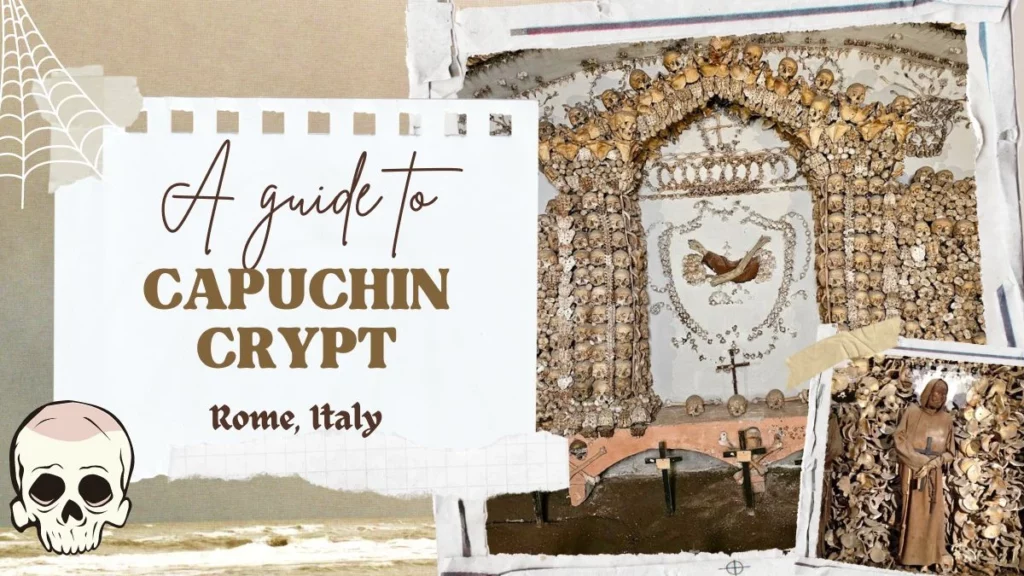
The Capuchin Crypt (Cripta dei Cappuccini) beneath the Church of Santa Maria della Concezione on Via Veneto is one of Rome’s most extraordinary and unsettling sights: six underground chapels decorated floor-to-ceiling with the bones and skeletal remains of approximately 3,700 Capuchin friars who died between 1528 and 1870. Open daily 10:00 am–7:00 pm (last entry 6:30 pm). Guided crypt tour: adult €42 / child 6–17 €40 / under 6 free. Photography and filming strictly prohibited throughout. Dress code required (shoulders and knees covered). Not suitable for very young or sensitive children.
Via Veneto — Rome’s glamorous boulevard of grand hotels and pavement cafés, immortalised by Fellini in La Dolce Vita — contains a secret that stops visitors dead. At the southern end of the street, beneath the Church of Santa Maria della Concezione dei Cappuccini, lies one of the most extraordinary memento mori in the world: six underground chapels whose walls, arches, columns, chandeliers, and ceiling decorations are composed entirely of human bones.
Between 1631 and 1870, Capuchin friars arranged the skeletal remains of approximately 3,700 of their deceased brethren into decorative compositions: vertebrae arches, femur columns, skull-decorated niches, complete robed skeletons hanging from the ceiling, and pelvis rosettes. A placard near the entrance delivers the chapel’s message with lapidary simplicity: ‘What you are now, we once were; what we are now, you shall be.’ This is not a horror attraction — it is a profound and sincere meditation on human mortality within the Catholic tradition, and the artistry and care of the bone arrangements gives it an atmosphere of austere, genuinely moving solemnity.
The Crypt is also home to a small museum dedicated to Capuchin history, art, and spirituality, and to the church above — itself containing Guido Reni’s St Michael Trampling Satan and Caravaggio’s St Francis of Assisi in Ecstasy (one of his early masterpieces). This guide covers everything you need to know before visiting in 2026.
Top Tickets
# Guided tour of the Capuchin Crypt
# Guided tour of Roman Crypts and Catacombs
Book Capuchin Crypt guided tour tickets online before visiting — popular time slots sell out, particularly on weekends and in the April–October high season. Photography and filming are strictly prohibited throughout the crypt (this rule is enforced). Dress code is mandatory: shoulders must be covered, knees must be covered, no low-cut clothing. The guided tour departs from the meeting point — arrive 10–15 minutes before your booked slot. Not recommended for very young or sensitive children.
A 1-hour English-language guided tour of the Crypt with a maximum of 10 guests per group — intimate and atmospheric. Your guide provides historical, artistic, and theological context for the bone chapels, the Capuchin order, and the significance of memento mori in Catholic tradition. Tours begin at 9:00 am; select your preferred time slot when booking.
| Category | Price | Notes |
| Adult (18+ years) | €42 | Max 10 guests; English-speaking guide; 1 hour |
| Child (6–17 years) | €40 | — |
| Child (up to 5 years) | Free | — |
A 3.5-hour tour of multiple underground sites across Rome, travelling between locations by private air-conditioned coach. The tour covers catacombs beneath cathedrals, crypt chapels, underground chambers, and sites of historical religious significance across the city. Maximum 20 participants; expert English-speaking guide throughout. Strollers, wheelchairs, and visitors requiring special assistance cannot be accommodated on this tour.
| Category | Price | Notes |
| Adult (15+ years) | €60 | 3.5-hour tour; max 20 participants; private coach |
| Child (2–14 years) | €55 | — |
| Infant (up to 1 year) | Free | — |
Buy a Roma Pass and visit one or two of Rome’s top attractions with access to public transport. Choose either a 48-hour or a 72-hour pass and get direct entry into the city’s famous gems.
The Capuchin Crypt is open daily from 10:00 am to 7:00 pm. Last entry is at 6:30 pm. The guided tour begins at 9:00 am for pre-booked tour groups. Roma Pass does NOT include entry to the Capuchin Crypt.
| Day | Opens | Last Entry | Closes |
| Daily (all week) | 10:00 am | 6:30 pm | 7:00 pm |
| Pre-booked guided tours | From 9:00 am | — | — |
The guided crypt tour lasts approximately 1 hour. Independent visitors exploring the crypt at their own pace typically spend 45–60 minutes. Art and history enthusiasts who also visit the church above — which contains Guido Reni’s St Michael and Caravaggio’s St Francis in Ecstasy — may spend 1.5–2 hours in total.
The best time to visit the Capuchin Crypt is at 10:00 am when it opens on a weekday. The crypt is small and crowd-sensitive — the atmosphere is entirely different on a quiet morning versus a crowded afternoon. Weekends, especially in summer and autumn, see heavy foot traffic. Early-morning pre-booked guided tours offer the most intimate experience.
The first and most restrained room: a depiction of the Resurrection using skulls and bones arranged around a fresco of the risen Christ. Sets the theological tone for the spaces that follow — this is not macabre spectacle but Catholic meditation on the passage from death to eternal life.
A functioning chapel where Mass was historically celebrated among the bones of the fraternal dead. A fully decorated altar area. The scale of bone decoration here is notable — decorative friezes, arches, and dividing screens composed entirely of skeletal material.
The most geometrically elaborate of the six spaces: hundreds of skulls arranged in arched frames, circular patterns, and decorative roundels. The artistry is extraordinary — these are not piles of bones but carefully designed compositions.
Named for the dominant bone type arranged across its surfaces. The bone decorations here have a flower-like, almost heraldic quality that is unexpectedly beautiful.
The space that most impresses with sheer scale: the longer bones of the body — femurs and tibiae — arranged in alternating patterns across the arched ceiling and walls, punctuated by complete skulls and vertebral decorations.
The final and most dramatic space: three complete robed skeletal figures — their identity uncertain, though one is traditionally identified as a child of the Barberini noble family — hanging in the centre of the room. A scythe and scales symbolise death and divine judgement. The most photographed space in the crypt — and also the most strictly enforced no-photography zone.
| Rule | Details |
| Photography / filming | Strictly PROHIBITED throughout the crypt — no exceptions |
| Dress code | Shoulders covered, knees covered, no low-cut clothing |
| Bags | No large bags or suitcases; free lockers available outside |
| Strollers | Prohibited on the Roman Crypts and Catacombs tour |
| Wheelchair access | NOT available on the Roman Crypts and Catacombs tour |
| Behaviour | Silence and respectful demeanour required throughout |
Address: Via Veneto, 27, 00187 Roma (entrance to the right of the church)
| Transport | Details |
| Metro | Line A — Barberini stop (3 min walk up Via Veneto) |
| Bus | Lines 52, 53, 63, 80, 116, 492 — Barberini stop |
| On Foot | 5 min from Trevi Fountain; 10 min from Spanish Steps; 15 min from Piazza Navona |
Here are some questions tourists ask before purchasing their tickets for Capuchin Crypt in Rome.
The crypt contains the skeletal remains of approximately 3,700 human beings arranged as decoration. Many adults find it profoundly moving; some find it disturbing. Children vary widely in their response. Children under 6 are admitted free but parents should consider their child’s sensitivity carefully. The crypt is not recommended as a casual attraction for very young children.
No — Roma Pass does not cover the Capuchin Crypt.
Cancel up to 24 hours before your visit for a full refund.
The entrance to the Capuchin Crypt and Museum is through the small doorway to the right of the Church of Santa Maria della Concezione, at Via Veneto, 27. Do not enter through the church’s main doors — the crypt has its own entrance.
The official Palace of Versailles website is chateauversailles.fr, and its Tickets and prices page leads…
The official Spanish Riding School website is srs.at, and its Tickets and Events page leads…
The official Louvre website is louvre.fr, and its Book a ticket button leads to the…
The official Pantheon website is pantheonroma.com, run by the Chapter of Santa Maria ad Martyres.…
The official Accademia Gallery website is galleriaaccademiafirenze.it, where the Tickets page links to the official…
The official Bernabéu Tour website is realmadrid.com, and its Tour Bernabéu page links to the…


