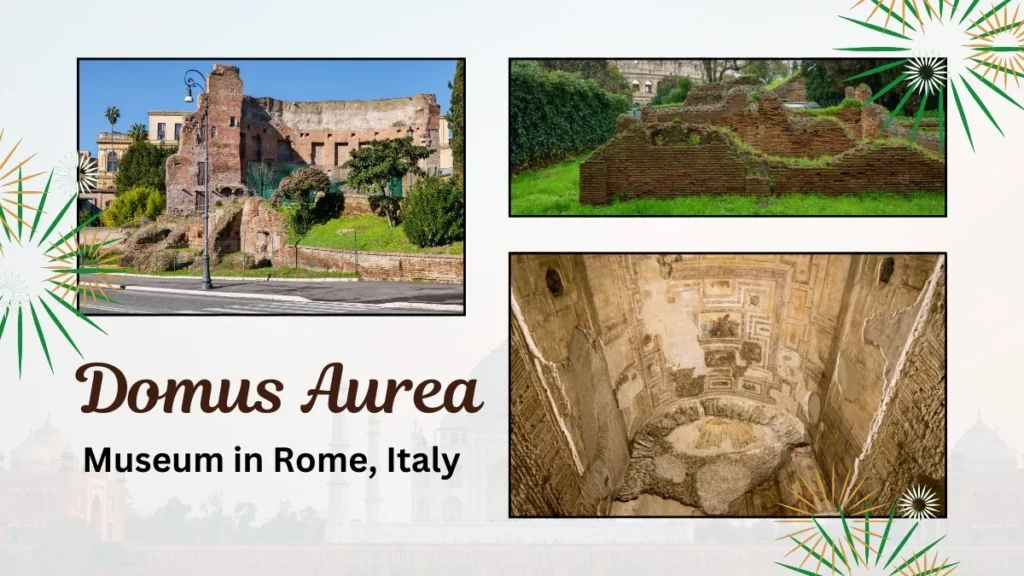
The Domus Aurea (Golden House) is Nero’s vast imperial palace complex buried beneath the Oppian Hill, accessible via Colle Oppio park near the Colosseum. Open Mon–Sun 9:45 am–5:00 pm. Strictly timed entry — limited to 23 visitors per slot at 9:30 am, 10:00 am, 11:45 am, 2:00 pm, and 3:45 pm. 2-hour guided tour with VR: €101 adult / €90 child or student. 90-min guided tour without VR: €72. Not wheelchair accessible. Roma Pass NOT accepted. Book well in advance — slots are extremely limited.
In 64 AD, a fire destroyed a large section of central Rome. Whether Nero started it (as ancient gossip suggested) or simply took advantage of it (as historians generally conclude), the aftermath gave him the opportunity to build something unprecedented: a private imperial palace on a scale that shocked even Romans accustomed to imperial excess. The Domus Aurea — the Golden House — covered an estimated 80 hectares of the city’s heart: from the Palatine Hill across the valley of the future Colosseum to the Esquiline and Caelian hills. Within it were gardens, pavilions, a rotating dining room, a 30-metre-high bronze statue of Nero (the Colossus), an artificial lake, and hundreds of decorated rooms. Ancient sources described a vestibule so large that a colossal statue could stand within it.
Nero died in 68 AD, before his palace was completed. His successors — Vespasian, Titus, and Trajan — stripped, demolished, and buried sections of the building under new construction projects, deliberately erasing Nero’s memory. The artificial lake was drained to build the Colosseum (69–79 AD). Trajan’s Baths (104 AD) were built directly on top of the buried Domus Aurea, and the earth fill used to support them preserved the palace’s frescoed halls for nearly 1,500 years.
The Domus Aurea was rediscovered in the late 15th century, when Renaissance artists (including Raphael, Michelangelo, and Giovanni da Udine) were lowered through holes in the Esquiline hillside to see what they called ‘the grottoes’ — and were so dazzled by the painted decoration that they developed an entirely new decorative style (grotesque) based on the ceiling frescoes. Excavations began in the 16th century and continue today: the Domus Aurea is Rome’s largest active archaeological site. It reopened to the public in 1999 after 20 years of restoration.
Top Tickets
# 2-hour guided group tour of Domus Aurea
# 90-minute Domus Aurea, Nero’s Golden House tour
The Domus Aurea has some of the most restrictive entry limits of any attraction in Rome — a maximum of 23 visitors per time slot, with only 5 slots per day. Book online well in advance, especially for weekend visits or during peak season (March–October). Exchange your smartphone voucher with Touristation staff at the gate on Via della Domus Aurea/Via Nicola Salvi — look for staff in red jackets carrying orange umbrellas. The site is NOT wheelchair accessible and NOT suitable for visitors with serious mobility difficulties. Not included in Roma Pass.
The full Domus Aurea experience: a 2-hour guided tour of the excavated palace halls combined with a 3D virtual reality reconstruction showing the Domus Aurea as it appeared in the 1st century AD at the height of Nero’s empire. The VR element is among the most impressive available at any Roman archaeological site — the contrast between the buried brick vaults of today and the gold-leafed, frescoed splendour of the reconstruction is extraordinary.
| Category | Price | Notes |
| Adult (18+ years) | €101 | 2-hr tour + VR; max 23 per slot |
| Child (5–17 years) | €90 | — |
| Student (18–24 with valid ID) | €90 | Valid student ID required on the day |
| Infant (up to 4 years) | Free | — |
A 90-minute expert-guided tour of the Domus Aurea halls without the virtual reality component — covering the key frescoed rooms, the mosaic water basin, the octagonal room with its light show, and the story of Nero’s palace and its extraordinary history of burial, discovery, and rediscovery. This tour also debunks the myths surrounding Nero and the Great Fire of 64 AD.
| Category | Price |
| All visitors | €72 |
The Domus Aurea opens at 9:45 am and closes at 5:00 pm Monday to Sunday. Entry is STRICTLY TIMED — maximum 23 visitors per slot. Available slots: 9:30 am, 10:00 am, 11:45 am, 2:00 pm, and 3:45 pm. Book your specific slot when purchasing — there is no flexibility on arrival time. Tours last 90 minutes to 2 hours depending on the ticket option.
| Day | Slots Available | Visitors per Slot | Opens | Closes |
| Monday–Sunday | 9:30, 10:00, 11:45 am, 2:00, 3:45 pm | 23 maximum | 9:45 am | 5:00 pm |
With only 5 time slots and a maximum of 23 visitors per slot, the Domus Aurea can accommodate a maximum of 115 visitors per day. This is one of Rome’s most capacity-limited attractions. Book as far in advance as possible, particularly for weekends and summer visits. You WILL miss your slot if you arrive late — there is no late admission.
Buy a Roma Pass and visit one or two of Rome’s top attractions with access to public transport. Choose either a 48-hour or a 72-hour pass and get direct entry into the city’s famous gems.
The best time to visit the Domus Aurea is at the 9:30 am or 10:00 am slot on a weekday. Early slots are coolest — the underground site maintains a steady cool temperature year-round but the approach through Colle Oppio park is pleasant in the morning. Weekends book out furthest in advance; secure a weekend slot at least 2–3 weeks ahead in peak season. Avoid 3:45 pm in summer as the park approach can be hot.
The Domus Aurea’s corridors are among its most immediately impressive features: wide, high-ceilinged, and extending far into the hillside in a way that makes the scale of the palace viscerally real. Much of the original decoration has been lost, but enough survives — traces of painting, stucco mouldings, the geometric floor patterns — to convey the density of decoration that once covered every surface.
The Domus Aurea’s painted decoration was so influential that Renaissance artists coined the term ‘grotesque’ (from ‘grotta’ — grotto — the word they used for the buried rooms) to describe the style of interlaced figures, fantastic creatures, architectural motifs, and foliage that covered the vaulted ceilings. The most significant surviving fresco programmes are the Pompeian-style scenes in the main galleries, the Andromache and Hector frescoes in the later rooms, and the Anubis figure in one of the most complete surviving cubicles.
One of the Domus Aurea’s most remarkable surviving decorative elements: a ceiling mosaic above a water basin in one of the nymphaeum rooms, depicting the scene from the Odyssey in which Ulysses blinds the Cyclops Polyphemus. Historians consider this one of the earliest surviving examples of figurative mosaic work on a curved ceiling surface — a composition that anticipated Byzantine and early Christian vault decoration by centuries.
One of the oldest and best-preserved rooms in the Domus Aurea: the original dining room, which retains its mosaic floor and sections of original wall painting. Roman banquets — convivia — at the Domus Aurea were described by ancient sources as lasting days, with courses designed to showcase every variety of Roman luxury. The scale and decoration of the room reflect the ambition of those events.
The architectural highlight of the surviving Domus Aurea: a large octagonal vaulted room lit by a central oculus (open to the sky through the hill above) — one of the most innovative spaces in ancient Roman architecture and a direct precursor to the domed rotunda tradition that culminated in the Pantheon and Hagia Sophia. Ancient sources describe a rotating dining room in the Domus Aurea, believed by some archaeologists to be this space. Today, the tour ends with a light installation that animates the room’s geometry.
Throughout the Domus Aurea’s corridors, large irregular holes can be seen in the vaulted ceilings — some from the original collapse, but the most striking from the Renaissance period, when treasure hunters lowered themselves into the buried palace on ropes to steal marble, metals, and decorative materials. The holes that brought Raphael and Michelangelo down to see the grotesque paintings are among the most historically significant ‘damage’ to any ancient site.
Recommended attractions
Address: Via della Domus Aurea (entrance through Colle Oppio park), 00184 Roma
| Transport | Details |
| Metro | Line B — Colosseo stop (5 min walk through Colle Oppio park) |
| Bus | Lines 53, 75, 85, 87, 117 — Colosseo stop |
| On Foot | 3 min from the Colosseum; 10 min from the Capitoline Hill |
After being hidden for centuries and nearly erased by Nero’s successors, the Domus Aurea was rediscovered in the 15th century. It reopened in 1999 after 20 years of restoration and still stands as Rome’s largest active archaeological site—where archaeologists are still unearthing the grandeur of Nero’s palace.
For most visitors, yes. The contrast between the stripped-brick vaults of the surviving Domus Aurea and the VR reconstruction of the gold-leafed, frescoed palace at its peak is the single most effective way to understand the site’s original magnificence. Particularly valuable for visitors without specialist knowledge of Roman architecture.
No — Roma Pass does not include the Domus Aurea.
No — the Domus Aurea tour is not suitable for wheelchair users or visitors with serious mobility impairments.
The official Palace of Versailles website is chateauversailles.fr, and its Tickets and prices page leads…
The official Spanish Riding School website is srs.at, and its Tickets and Events page leads…
The official Louvre website is louvre.fr, and its Book a ticket button leads to the…
The official Pantheon website is pantheonroma.com, run by the Chapter of Santa Maria ad Martyres.…
The official Accademia Gallery website is galleriaaccademiafirenze.it, where the Tickets page links to the official…
The official Bernabéu Tour website is realmadrid.com, and its Tour Bernabéu page links to the…


